A well-placed sign can turn an unfamiliar storefront into an easy-to-find destination. A Frontlit Sign uses external lighting to illuminate its printed face, making it a practical option for businesses that need clear visibility after dark. The format can appear as a projecting sign, a wall-mounted panel, a cabinet sign, or a large-format display. Each has different needs for viewing distance, mounting space, and maintenance.
Industry research shows why visibility deserves careful planning. FedEx Office’s 2016 consumer survey found that 76% of respondents had entered a store they had not previously visited because of its signage. The same survey reported that 68% had purchased a product or service after noticing a business sign. Separately, the Outdoor Advertising Association of America, using MRI-Simmons audience data, has reported that out-of-home advertising reaches about 90% of U.S. adults monthly. These figures cover broad signage and advertising categories; they do not prove that one frontlit design outperforms another. That distinction matters.
The right choice depends on the site, not just the sign’s appearance. A compact cabinet may suit a narrow façade, while a pylon sign can help drivers spot a business from farther away. Lighting angle, glare, material, and upkeep all affect the result. Small details count. This guide compares common frontlit sign types, their typical applications, and the practical trade-offs worth considering before choosing one. Some installations still disappoint, even with good materials. Placement is easy to underestimate.
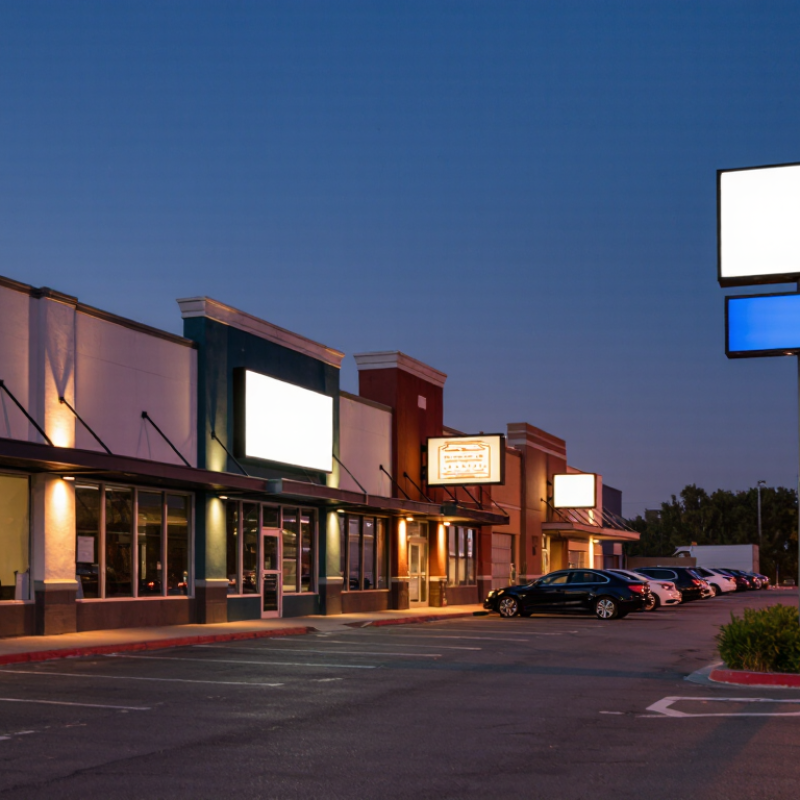
A frontlit sign has an opaque or translucent face lit by fixtures mounted outside the sign. Floodlights or adjustable spotlights can wash the lettering with light after dark. The result depends on placement. A lamp aimed too low may leave the top dim; one aimed toward passing drivers can cause glare. Small details matter.
UL 48 covers electrical safety requirements for electric signs, including aspects of construction and wiring. A sign’s lighting equipment and enclosure should be selected and assembled with the applicable requirements in mind. Do not assume that a certified light fixture makes the complete sign compliant. Check the sign’s certification information and installation instructions, and confirm local requirements with a qualified sign professional. Rules can vary by location.
On site, look for secure mounting, protected wiring, and fixtures rated for their exposure to rain and dust. Keep light sources aimed at the sign face, not nearby windows or traffic. A quick evening inspection often reveals uneven patches that are easy to miss in daylight. I’ve seen a neat daytime installation look surprisingly harsh at night; adjusting the angle helped, though it did not fix every shadow. That is worth checking before the sign is considered finished.

Frontlit vinyl banners are commonly specified at 13, 15, or 18 oz per square yard. The weight describes the material, not the finished banner. Commercial fabric specifications use this range for everyday promotions, event backdrops, and longer-term outdoor displays. A 13 oz banner is easier to handle and transport. An 18 oz version feels more substantial and may suit repeated use. Heavier is not automatically better.
Check the measurement basis. ISO 2286-2 describes how to determine the mass per unit area of coated fabrics, while ASTM D751 covers tests for coated fabrics, including strength-related properties. These standards help buyers compare measurable traits; neither says weight alone predicts service life. Ask for the fabric’s weight, coating details, and tear or tensile data. Then check hems, grommet spacing, and how the banner will be mounted. A heavy sheet with weak finishing can still fail.
Wind matters. A large outdoor banner catches gusts like a sail, so installation can matter as much as fabric weight. For a short indoor promotion, 13 oz may be practical. For frequent handling, 15 or 18 oz can offer a sturdier feel. One detail is easy to overlook: printed colors and lighting can look different across materials. Request a sample when color accuracy matters. That extra check is worth the trouble.
What Are the Top Types of Frontlit Signs?
Frontlit cabinet signs are a practical choice when a business needs bright, readable messaging after dark. Their aluminum faces cover a shallow cabinet, while LEDs inside cast light forward through the sign face. A smooth, evenly lit panel can make lettering easy to read from across a parking lot. But uneven illumination can create distracting bright spots, especially near the edges.
Aluminum offers a useful balance of strength and manageable weight. Face thickness, cabinet depth, and mounting conditions all affect how well a sign holds up outdoors. LEDs use less energy than many older lighting systems, but they still need proper wiring, ventilation, and access for maintenance. Ask whether the complete electric sign is evaluated to UL 48 requirements, and confirm that its components and installation meet applicable local rules. A UL mark on one part alone does not necessarily cover the finished sign.
Tips: Check the face after dusk, not just in daylight. Look for dim corners, visible seams, and glare from nearby windows. Also ask how technicians will reach the LEDs without damaging the aluminum face. This detail is easy to overlook. In practice, even a well-built cabinet may need occasional cleaning or repair, so service access matters as much as initial brightness.
What Are the Top Types of Frontlit Signs?
Frontlit Channel Letters: Typical 3–5 in Returns and Raceway Mounting
Frontlit channel letters combine translucent faces, LED modules, and metal returns. A 3–5 inch return is common, not mandatory. It can provide room for wiring and modules while giving each letter a defined side profile. Deeper returns do not automatically prevent bright spots; module spacing, face material, and optics matter too. Check a physical sample after dark. Renderings can hide glare.
A raceway groups letters on a narrow metal enclosure that carries wiring and simplifies installation. It can be practical on masonry or finished façades, where separate letter mounting means more penetrations. The trade-off is visual: the enclosure may interrupt a clean sign band. Match its finish to the wall when possible. The U.S. Department of Energy’s Energy Saver guidance reports that LEDs use at least 75% less energy than incandescent lamps. That is a general lighting benchmark, not a direct comparison of complete sign systems. Actual sign consumption depends on power supplies, operating hours, and controls. Measure the mounting area carefully. Leave enough access for service, but avoid excess cable slack that makes the installation look untidy.
Frontlit channel letters commonly have returns 3–5 inches deep. Raceway mounting is an installation option; the chart shows the typical return-depth range, not a mounting measurement.
Frontlit pylon and monument signs face wind as complete structures, not merely illuminated panels. A tall pylon can experience substantial overturning forces because wind acts high above grade. A broad monument sign may catch more wind across its face. Details matter. Cabinet seams, pole connections, anchor bolts, and foundation depth all affect performance.
ASCE’s Hazard Tool, using ASCE 7-22 hazard data, provides site-specific wind parameters for structural design. Engineers also consider risk category, exposure, elevation, topography, sign height, and projected area. These inputs matter: a sign near an open field may face different wind conditions from one sheltered by dense buildings. The 2024 International Building Code references wind-load standards, but local jurisdictions may adopt different code editions or amendments. Confirm the applicable requirements before design or permitting.
Local review can also address setbacks, footing dimensions, soil conditions, and inspection requirements. A geotechnical report may reveal weak or saturated soil that requires a larger foundation. On site, check that anchor bolts match the approved drawings and remain properly embedded after concrete placement.
Not just the panel.
One easy-to-miss issue is a change in sign cabinet size after engineering review; added area can alter wind demand. Have the structural engineer reassess revisions rather than relying on the original calculations.