“Design is the silent ambassador of your brand,” wrote graphic-design pioneer Paul Rand. That idea matters when sourcing Custom Signs: a sign must communicate clearly before a customer reaches the door. China offers manufacturers for illuminated storefront letters, acrylic displays, metal plaques, and large-format wayfinding. Yet a polished catalog is not proof of dependable production.
A useful search starts with the product, not a broad “best factory” claim. Compare suppliers on materials, fabrication methods, finishing, and experience with similar projects. Ask for dated project photos, close-up details, and references you can verify. Request a sample or a small pilot order when practical. Check how the factory handles artwork approval, color matching, packaging, and shipping updates. These details reveal more than a low quote.
The right partner should explain trade-offs plainly. For example, ask how an outdoor sign’s coating, lighting components, and mounting method suit its intended location. Confirm specifications in writing, including dimensions, tolerances, and inspection points. A video call can help, but it cannot replace independent checks. I would not treat one certificate or showroom visit as a guarantee. Not enough. That assumption is too easy.
This guide will show where to look, what questions to ask, and how to compare candidates without relying on slogans. Some factories may be excellent at one sign type and average at another. That distinction matters. The goal is not merely to find a supplier in China, but to find a capable manufacturer whose process fits your project, budget, and quality expectations.
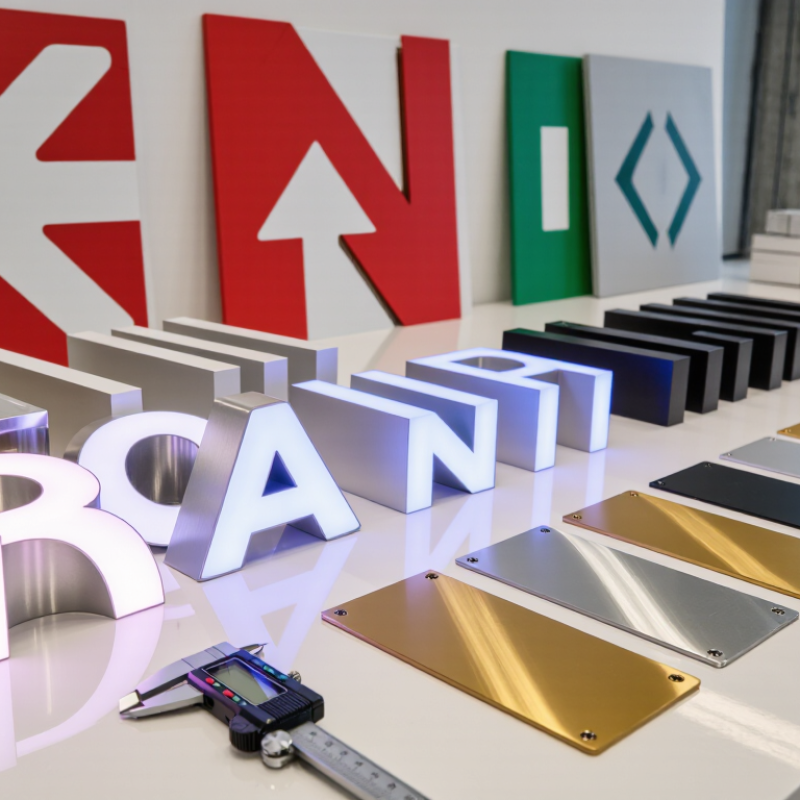
Custom sign manufacturers in China produce far more than printed shop panels. Common products include illuminated channel letters, acrylic and stainless-steel lettering, light boxes, wayfinding signs, directory boards, and indoor or outdoor LED displays. They also make reception signs, building identification, exhibition graphics, and custom-shaped retail displays. Materials often include aluminum, acrylic, stainless steel, and LED modules. The right choice depends on viewing distance, installation surface, lighting, and weather exposure.
Demand for digital signage provides useful industry context. Grand View Research estimated the global digital signage market at USD 28.83 billion in 2023, with projected growth through 2030. That figure describes the market, not Chinese manufacturers’ output. For a specific project, buyers should request material specifications, wiring details, production drawings, and photos of comparable work. Small details matter: a deep channel letter casts a different shadow than a flat panel. One practical wrinkle is that a polished sample may not show how a sign performs outdoors.
Many factories can combine fabrication steps, such as cutting metal, forming letter returns, applying finishes, and assembling lighting. Ask how they control color consistency and test illumination across a complete sign. For wayfinding systems, check that arrows, room names, and mounting heights match the approved drawings. A sample helps. Still, it cannot replace a clear installation plan, especially for large or multi-piece signs.

Custom sign manufacturers commonly produce channel letters, illuminated acrylic signs, light boxes, printed panels, and engraved plaques. Bars show the typical number of production methods used for each sign type—not market share or production volume. Exact methods vary with the design and materials.
China’s sign manufacturers are concentrated in several coastal industrial regions, rather than one single production city. Guangdong’s Pearl River Delta is a major sourcing area, with suppliers around Guangzhou, Shenzhen, Dongguan, and Foshan. The region’s dense network of electronics, metalworking, plastics, and printing businesses supports custom indoor and outdoor signs. A workshop may source LED modules nearby while outsourcing a stainless-steel frame to a neighboring factory. That proximity can help with coordination, though it does not guarantee consistent quality.
The Yangtze River Delta, including parts of Jiangsu, Zhejiang, and Shanghai, offers another broad manufacturing base. Buyers may find producers of acrylic displays, metal letters, illuminated signs, and retail fixtures across its industrial cities. Capabilities vary by town and supplier. Ask where each production step happens.
For a more reliable comparison, request recent photos of the workshop, material specifications, and a sample made to your drawing. Check how the supplier handles wiring, surface finishes, packaging, and design changes. A polished catalogue can hide a thin production team; I would treat that as a reason to ask more questions, not an automatic rejection. Distances between suppliers can also complicate shared projects, so confirm who manages assembly and final inspection before placing an order.
A strong supplier assessment begins with evidence, not a polished factory tour. Grand View Research’s 2023 Digital Signage Market report valued the global market at USD 26.11 billion. It projected 8.1% annual growth through 2030. That expansion signals demand, not dependable workmanship.
For illuminated letters, request a production sample, material grades, wiring diagrams, and written tolerances. Inspect cut edges, welded corners, paint coverage, and cable strain relief under ordinary lighting. Ask how the factory checks color consistency between batches. Ask to see proof. A clear inspection record should identify the inspector, date, defects, and corrective action. For outdoor signs, request test reports for the specified enclosure rating and materials. Match the report to the actual design.
Check whether quoted capacity includes finishing, assembly, and packing, not just cutting machines. Review a recent production record and compare approved drawings with packed goods. A remote video call helps, but it cannot reveal every weak seam or rushed repair. Even capable factories have uneven weeks; I would not approve a large order from one attractive sample. Build in a pilot run and keep a few questions open.
| Evaluation Area | Where to Find or Verify | What to Check | Practical Acceptance Check | Suggested Weight |
|---|---|---|---|---|
| Manufacturer discovery | Industry trade fairs, established B2B sourcing platforms, trade associations, and referrals from buyers or logistics providers. | Whether the supplier is the actual manufacturer, a trading company, or a combination of both. | Ask for the registered business details, factory address, product scope, and a live video walkthrough or in-person factory visit. | 10 points |
| Product and process capability | Factory tour, technical discussion, sample review, and production records for comparable sign projects. | Relevant processes such as metal fabrication, acrylic cutting, printing, LED assembly, finishing, and wiring, as applicable to the order. | Confirm that the facility and documented production process match the materials, construction, dimensions, and finish specified in the quotation. | 15 points |
| Engineering and design support | Request a drawing review, prototype discussion, or design-for-manufacturing assessment. | Ability to review artwork, dimensions, mounting details, material choices, electrical requirements, and installation constraints. | Require written approval of drawings, materials, colors, dimensions, and tolerances before production begins. | 10 points |
| Material traceability | Material specifications, purchase records, supplier declarations, and sample inspection. | Specified material grade, thickness, coating or finish, LED and power-supply specifications, and consistency between approved samples and production. | List critical materials and specifications in the purchase order; request supporting documents where material performance or compliance matters. | 10 points |
| Quality management | Quality procedures, inspection records, corrective-action examples, and a review of any claimed management-system certificates. | Incoming-material checks, in-process inspection, final inspection, defect handling, and certificate validity and scope. | Ask for an inspection plan tied to the product requirements. A management-system certificate alone does not prove that a particular sign meets its specification. | 15 points |
| Prototype and sample approval | Pre-production sample or first-article inspection before a full production run. | Appearance, dimensions, color, illumination, construction, packaging, and operation against the approved drawings and sample. | Record approval in writing and identify the approved sample or revision as the production reference. | 10 points |
| Electrical and regulatory requirements | Test reports, component documentation, product labels, and review by a qualified compliance professional when required. | Applicable destination-market rules for electrical signs, power supplies, wiring, ingress protection, fire performance, and labeling. | Confirm which party is responsible for compliance and verify that documents apply to the actual product, components, and target market. Requirements vary by product and destination. | 10 points |
| Production capacity and delivery | Production schedule, capacity explanation, workforce and equipment review, and shipment records where available. | Current workload, realistic lead time, subcontracted processes, production milestones, and contingency planning. | Use a written schedule with approval, production, inspection, and dispatch milestones; confirm any outsourced steps and who controls them. | 10 points |
| Packaging and shipping readiness | Packaging specification, sample pack-out, and discussion with the buyer’s freight forwarder. | Protection for fragile faces, projecting components, finishes, and electrical parts; carton or crate markings and shipment dimensions. | Approve packaging for the transport method and ask for pre-shipment photos. Confirm shipping terms, export documents, and responsibility for freight and insurance in writing. | 5 points |
| Commercial terms and after-sales support | Written quotation, purchase contract, warranty terms, and documented communication with the supplier. | Specification coverage, payment milestones, change control, defect remedies, spare parts, warranty exclusions, and response process. | Ensure the contract identifies the approved specification, inspection rights, delivery terms, acceptance process, and remedy for nonconforming goods. | 5 points |
| Suggested total score: rate each area from 0 to 5, then apply the listed weight proportionally. Use the score to compare shortlisted suppliers, not as a substitute for samples, inspections, or compliance checks. | 100 points | |||
When comparing custom sign manufacturers in China, treat certificates as evidence to inspect, not decoration. Ask for the certificate number, issuing body, covered product category, factory address, and expiry date. Verify these details with the issuer or its searchable registry. A document for a trading office may not cover the workshop making your signs. Small detail, big difference.
Request a material schedule that identifies substrate, finish, ink, and hardware. Compare it with a physical sample and the written quotation. For outdoor signs, ask how the materials handle moisture, sunlight, and temperature changes. Review recent test reports, checking that they name the same materials and product type you plan to order. A report for a similar item is not always enough.
Production standards should be visible in the process. Ask for inspection checkpoints, measurement tolerances, color-matching methods, and records for rejected units. A short factory video can help, but it cannot replace a live audit or clear inspection documents. Ask how samples are approved and how changes are recorded before mass production. This takes time. Paperwork can still miss inconsistent workmanship, so consider a pre-shipment inspection. No single certificate guarantees a reliable sign; compare documents, samples, and production evidence together.
Choosing a sign manufacturer in China starts with a clear brief, not a low quote. Specify dimensions, materials, finish, lighting, installation environment, and packaging. The Grand View Research report valued the global digital signage market at USD 28.83 billion in 2023 and projected 8.1% annual growth from 2024 to 2030. That growth makes electronics and integration experience worth checking, even for a project combining digital and traditional signs. Market growth is not proof of a supplier’s skill.
Ask shortlisted factories for recent examples using similar materials and processes. Request a physical sample or a small paid prototype before approving a full production run. Check color under the lighting where the sign will be used; a finish that looks right on screen may appear different in a shop window. Small details matter. Confirm tolerances, wiring, mounting points, inspection steps, and packing requirements in writing. Ask who performs each process, since some suppliers outsource printing, metalwork, or assembly.
Agree on milestones for drawings, sample approval, production, and shipment. Request dated progress photos, but do not treat photos as a substitute for inspection. A third-party pre-shipment check can verify dimensions, finish, and quantity against the approved sample. Leave time for corrections. I have seen a tidy sample create too much confidence; batch consistency still needs checking. Record changes in one shared document, including the final artwork and specifications, so both teams work from the same version.